
Rapid population growth in the world causes many and big problems. One of the biggest problems is the increasing energy demand from year to year. Today, this energy, which is mostly met by fossil fuels, will run out in time and cause serious damage to the environment.
Considering these situations, it is seen that it is necessary to search for new energy sources.
At this point, Space-Based Solar Energy, which emerged to meet the global energy needs and end carbon dioxide emissions, is considered as a very suitable source for the future.
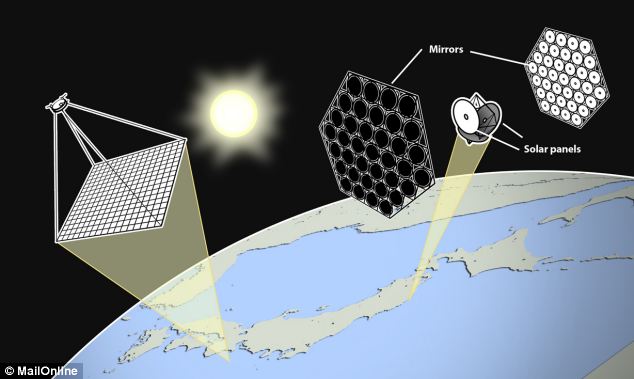
This system, put forward by Dr. Peter Glaser, aims to transform the electrical energy obtained by the Sun into a microwave, transmitting this microwave to the receiving antenna on the earth by using phased array antenna elements and converting it back into electrical energy.
The most striking feature of this system, which has many advantages, is that Space-Based Solar Energy systems will be able to collect this energy without being caught in the sun’s rays, since they will be located outside the atmosphere. Sun rays falling on modern solar panels; Atmospheric gases pass through clouds and other weather events and fall into these panels and therefore suffer great losses along the way. And besides, a solar panel design independent of the day and night cycle will be able to produce energy uninterruptedly, unlike solar panels on Earth.

However, despite all these advantages, this idea has still not been realized. There are a few simple reasons for this:
The very high costs of such technology make it highly unlikely to invest in them. Especially since the repair and maintenance costs of the energy generation and distribution systems in orbit are very high, and the astronauts who will have to work on them are exposed to high levels of radiation, these investments make these investments risky. If autonomous maintenance robots are to be produced instead of human workers, the flexible solution behaviors of humans will be lost and the calculated budget cost will increase considerably.
To reduce this cost, in the early 1970s, Gerard O’Neill drew attention to the problem of high launch costs and proposed to build SPS (Solar Power Satellite) in orbit with materials from the Moon. He suggested that launch costs from the Moon could be much lower than from Earth due to the low gravity and lack of atmospheric drag.
On April 30, 1979, NASA concluded in a report entitled “Lunar Resources Utilization for Space Construction” prepared by General Dynamics Convair division under NAS9-15560 that the use of lunar resources would be cheaper than Earth-based materials. there was. However, the prices were still too high.
Another problem is that technologies such as power generation and wireless energy transmission are not yet at a sufficient level in order for these designs to be used more than other energy sources. As long as it is not possible to re-transfer the energy to be obtained from space to the Earth, the project will not promise a solution.
Stay with science and knowledge.
Halit Yusuf Genç
Sources:
- S. White. Space-Based Solar Power. (19 Eylül 2013). Alındığı Tarih: 08 Nisan 2021.
- E. Yıldız, et al. (2015). Günebakan: Uzay Tabanlı Güneş Enerji̇ Si̇stemi̇. Havacılık Ve Uzay Teknoloji̇leri̇ Dergi̇si̇, sf: 27-38. | Arşiv Bağlantısı
- J. C. Mankins, et al. (Bilimsel Rapor, 2011). Background Material & Summary Prepared by the National Space Society on the International Academy of Astronautics Report On Space Solar Power.
- J. O. McSpadden, et al. (2003). Space Solar Power Programs And Microwave Wireless Power Transmission Technology. Institute of Electrical and Electronics Engineers (IEEE), sf: 46-57. doi: 10.1109/MMW.2002.1145675. | Arşiv Bağlantısı
- S. Sasaki. (2014). It’s Always Sunny In Space. Institute of Electrical and Electronics Engineers (IEEE), sf: 46-51. doi: 10.1109/MSPEC.2014.6808461. | Arşiv Bağlantısı
- Wikipedia. Space-Based Solar Power. (08 Mayıs 2021). Alındığı Tarih: 08 Mayıs 2021. Alındığı Yer: Wikipedia | Arşiv Bağlantısı
- https://evrimagaci.org/uzay-tabanli-gunes-enerjisi-uzayda-toplanan-gunes-enerjisini-dunyada-kullanmak-mumkun-mu-10338
 Engineer For Space