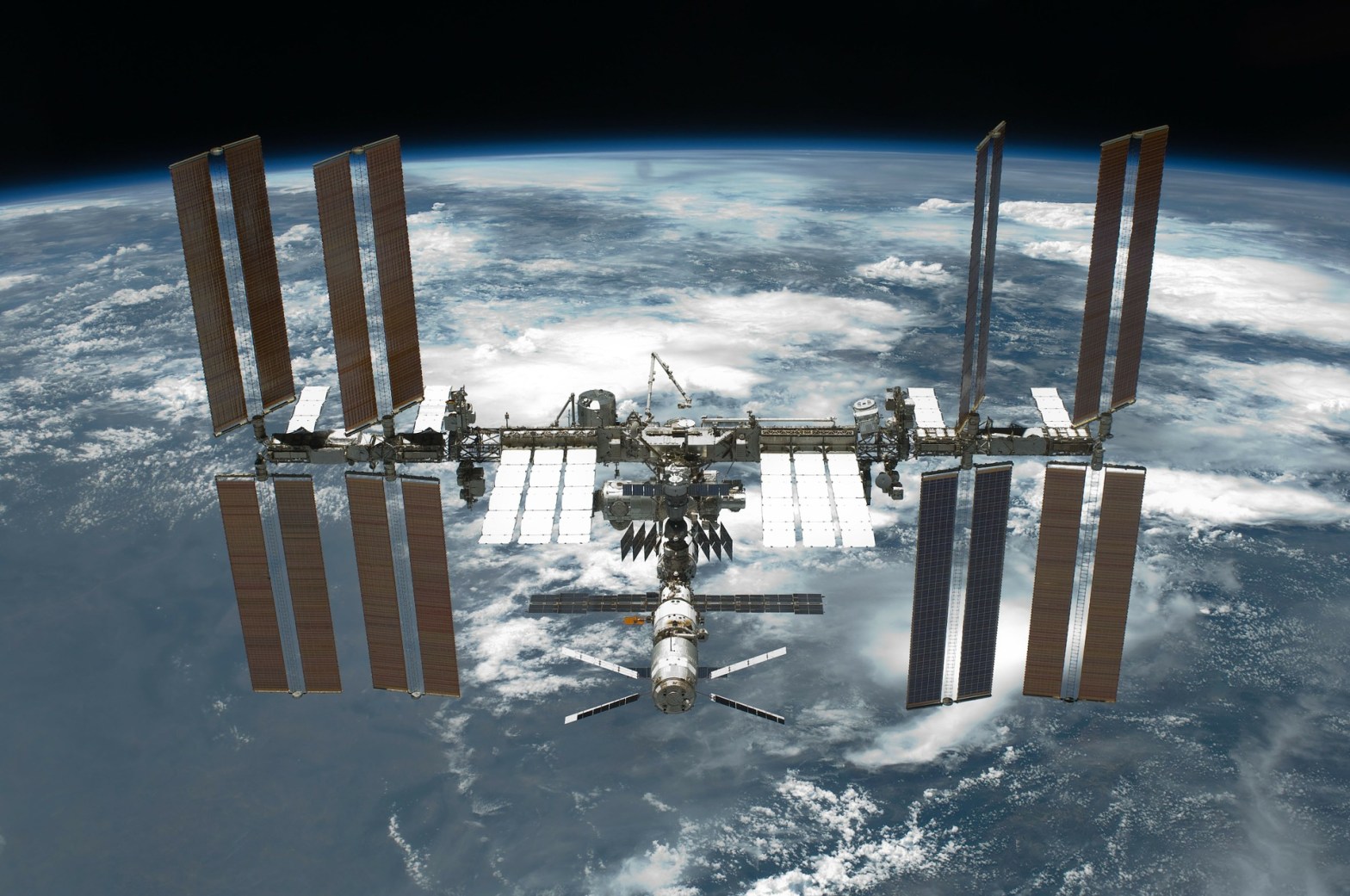
The International Space Station (ISS) is a space base placed in low Earth orbit, in other words, an artificial satellite that can be lived on. The first part of the station, which was built by combining the modules put together, was launched in 1998. The structure of the station basically consists of pressurized modules, supporting exoskeleton and solar panels. It is the largest artificial satellite orbiting the earth. It can be seen with the naked eye when viewed from the earth at appropriate times.
ISS is a laboratory center providing space environment and low gravity environment for experiments. It allows the crew to experiment in biology, physiology, physics, chemistry, astronomy, meteorology, and more. The station also provides a very suitable environment for testing equipment and systems planned for use in Lunar and Mars missions in space before use.
The station, which holds the record for the longest continuous human possession in space, has continuously accommodated and continues to accommodate the space crew for 7275 days since the Recon 1 shuttle arrived at the station on 2 November 2000. The previous record belonged to the Soviet space station Mir with 3644 days. ISS has hosted astronauts and cosmonauts from 15 different nations to date.
The International Space Station program is a joint project created by five participating space organizations, namely the US National Aeronautics and Space Administration, the Russian Federal Space Agency, the Japan Space Research Agency, the European Space Agency, and the Canadian Space Agency. Ownership and usage rights of the station are determined by intergovernmental treaties and conventions. The station consists of two parts, the Russian Orbital Division and the United States Orbital Division. The orbital altitude of the station is 330 km. up to 435 km. ranges between. The station uses the engines of the Zvezda module or visitor spacecraft to increase its altitude, which decreases over time. It makes 15.5 turns around the Earth in a day.
As a result of the USA’s budget increase, the station’s term of office has been extended from 2020 to 2024, and it is likely to be extended to 2028. It is still unclear whether countries such as Russia, Germany, France, Japan and Canada, which are currently supporting the project and declaring that they will support the project until 2020, will contribute to this extended budget. The Russian Federal Space Agency has made a bid to build a new station called OPSEK using the station before the International Space Station retires. ISS is the ninth station that has been built to date and accommodates personnel.
Purposes Of ISS Project
According to the original joint declaration of intent between the US National Aeronautics and Space Administration and the Russian Federal Space Agency, the International Space Station was planned to be a laboratory, observatory and factory. It was also planned to serve as transportation, maintenance and intermediate bases for the future Moon, Mars and various asteroid missions. In the US national space policy for 2010, the Station was given commercial, diplomatic and educational missions in addition to its current missions.
Scientific Researches
The International Space Station acts as an environment for research that cannot be carried out elsewhere. While small, unmanned spacecraft provide the environment for non-gravity and exposures to space, stations can host experiments that could last for decades. In this way, an environment that can go beyond the capabilities of manned space shuttles is created.
Microgravity
The International Space Station is affected by Earth’s gravity. Although gravity is less than the earth’s surface, it is not zero. But since the station is in continuous motion in orbit, gravity is balanced by centrifugal force. Researchers examine the effects of this near-weightless environment on development, growth, evolution and constitutive functions. NASA wants to do research on how 3D humanoid tissues are formed in microgravity.
As a result, ISS has performed great services on behalf of humanity in the process from its launch until today, and it still does. This project has been one of the best examples of what many nations have come together to achieve when the subject is science and research. The surplus that science and technology adds to the human race does not end and humanity develops as it develops.
Stay with science and knowledge.
Sources And Future Reading:
^ “Central Research Institute for Machine Building (FGUP TSNIIMASH) Control of manned and unmanned space vehicles from Mission Control Center Moscow” (PDF). Russian Federal Space Agency. Retrieved September 26, 2011.
^ “Nations Around the World Mark 10th Anniversary of International Space Station” (in English). NASA. November 17, 2008.Archived from the original on December 8, 2015. Accessed on March 6, 2009.
^ Price, Pat (2005). The Backyard Stargazer: An Absolute Beginner’s Guide to Skywatching With and Without a Telescope. Gloucester, MA: Quarry Books. s. 140. ISBN 1-59253-148-2.
^ “Human Space Flight” (in English). NASA. July 2, 2008.Archived from the original on December 21, 2015.
^ “International Space Station Overview”. ShuttlePressKit.com. June 3, 1999.Archived from the original on January 21, 2016. Retrieved February 17, 2009.
^ “Fields of Research”. NASA. June 26, 2007.Archived from the original on March 25, 2008.
^ “Getting on Board”. NASA. June 26, 2007.Archived from the original on December 8, 2007.
^ “ISS Research Program”. NASA. Archived from the original on August 11, 2010. Retrieved February 27, 2009.
^ “We’ve Only Just Begun”. NASA. 26 July 2008.Archived from the original on 16 March 2010. Retrieved March 6, 2009.
^ Gary Kitmacher (2006). Reference Guide to the International Space Station. Canada: Apogee Books. ss. 71–80. ISBN 978-1-894959-34-6. ISSN 1496-6921.
^ “Human Spaceflight and Exploration — European Participating States”. European Space Agency (ESA). 2009.Archived from the original on 24 November 2012. Retrieved January 17, 2009.
^ “ISS Intergovernmental Agreement”. European Space Agency (ESA). 19 April 2009.Archived from the original on 21 July 2011. Retrieved April 19, 2009.
^ NASA (December 15, 2008). “Current ISS Tracking data”. NASA. Archived from the original on December 25, 2015. Retrieved January 28, 2009.
^ Achenbach, Joel (January 8, 2014). “NASA: International space station operation extended by Obama until at least 2024”. washingtonpost.com. Retrieved January 8, 2014.
^ Clark, Stephen (March 11, 2010). “Space station partners set 2028 as certification goal”. Spaceflight Now. Archived from the original on March 24, 2016. Retrieved June 1, 2011.
^ “Canada’s space station commitment renewed”. CBC News. 29 February 2012.
^ “Memorandum of Understanding Between the National Aeronautics and Space Administration of the United States of America and the Russian Space Agency Concerning Cooperation on the Civil International Space Station”. NASA. January 29, 1998.Archived from the original on December 15, 2015. Retrieved April 19, 2009.
^ Payette, Julie (December 10, 2012). “Research and Diplomacy 350 Kilometers above the Earth: Lessons from the International Space Station”. Science & Diplomacy. 1 (4).
^ “National Space Policy of the United States of America” (PDF). White House; USA Federal government. Archived from the original on June 29, 2016 (PDF). Retrieved July 20, 2011.
^ Worldbook at NASA
^ “Mars500 study overview”. ESA. June 4, 2011. Archived from the original on July 31, 2012. Retrieved July 21, 2017.
^ “Space station may be site for next mock Mars mission”. New Scientist. November 4, 2011. Archived from the original on July 11, 2017. Retrieved July 21, 2017.
 Engineer For Space