When a high voltage is applied to a handful of aluminum balls in a container; A stylish “dance” emerges in which the particles rearrange themselves in a different “crystal” order. This behavior; It belongs to the phenomenon known as Wigner Crystallization, in which particles with the same electric charge repel each other to form an ordered structure.

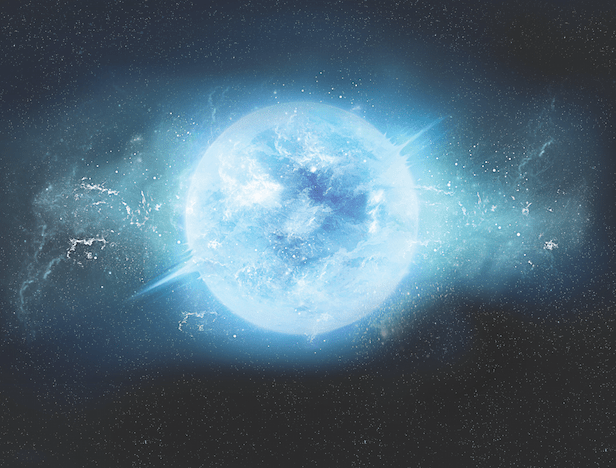
Wigner Crystallization has been observed in various systems, from the size of dust particles suspended in small electron and ion clouds, to the interiors of dense stars known as suspended white sand bodies from particles (called a dusty plasma). Professor Alex Bataller of North Carolina State University recently discovered that Wigner Crystallization within white dwarfs can be studied in the lab using a new class of classical systems called Gravity Crystals.
In order for this behavior of the Wigner Crystallization to occur, it consists of charged particles that are both free to move (plasma), strongly interact with each other (strongly bound particles) and have the presence of a confining force (to prevent the plasma particles from exploding propellantly away from each other). system should be.
To examine this situation for small scales in the lab, Dr. Bataller; He made a new arrangement that puts metal spheres in contact with a high-voltage surface, transferring hundreds of millions of electrons to their surface to charge the spheres, thereby increasing the particle. (Holds the thrust and the particles it contains) Additionally; When the spheres roll over the surface, their motion produces friction that rapidly reduces kinetic energy and promotes strong pairing.
The insight that made the current discovery possible was to use gravity as the limiting force. In this way, small charged spheres can be constrained by gravity using a simple geometry, a bowl.

Using gravitational confinement, Dr. Bataller discovered that Wigner crystallization could now be extended to macroscopic sizes with particles a million times larger than its powdered plasma cousin that could be used to study other crystal systems. For example, gravitational crystals can mimic an interesting feature of white dwarf stars called sedimentation. It has recently been discovered that layered crystal layers can form within white dwarf stars containing oxygen and carbon, where heavier oxygen “sinks” into the core. Gravity crystal arrangement; This produces the layering effect when high voltage is applied to the system of initially mixed copper and aluminum balls. Similar to sedimentation in white dwarf stars, copper balls are drawn towards the center of the bowl, preserving their crystalline structure.
The plasma properties and outer environment of a gravity crystal and a white dwarf star are different from what one can imagine, but both systems exhibit similar behavior, addressing the robust nature of Wigner Crystallization.
Researcher Bataller: The rich diversity in the systems in which we observe the “Wigner Crystallization” is a direct result of its nature independent of its scale. Gravity crystals require the least amount of resources while extending this phenomenon to human resources. What excites me most about this new platform is that anyone that intrigues is able to recreate the state of this fascinating substance, which has been limited to million dollar experiments so far. “
References & Future Readings:
Scitech Daily
Ntboxmag
For additional information see also:
P. E. Tremblay, G. Fontaine, N. P. G. Fusillo, B. H. Dunlap, B. T. Gänsicke, M. A. Hollands, J. Hermes, T. R. Marsh, E. Cukanovaite, and T. Cunningham, Nature 565, 202 (2019).
 Engineer For Space