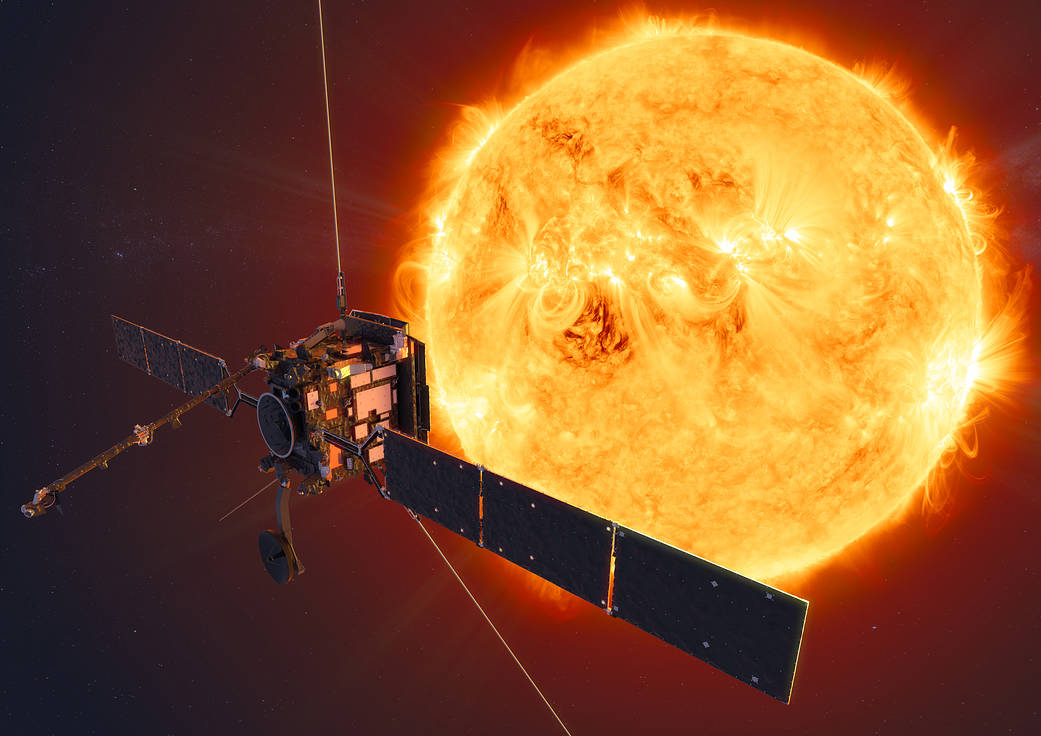
The phenomenon we call solar surfing is desired to be used in many space technologies. As we know, light photons actually have masses at the speed of light because they have a potential force. In this way, they can apply pressure as well as move objects. This phenomenon of moving spacecraft with the power of sunlight is called “solar surf”. This is one of the popular theories that are considered to be applied using sun rays.
Solar Surfing is an early-stage NASA study to support potential future missions that could travel closer to the Sun’s surface than ever before.
Today, NASA and its partners have a fleet of spacecraft studying the Sun. Since launching in 2018, Parker Solar Probe set a record as the closest spacecraft to the Sun. Of great interest to heliophysicists – scientists who study the Sun and its impact on the complex space weather system surrounding Earth, which can impact our technology in space – is the solar transition region, a very thin layer near the Sun’s surface. Parker Solar Probe will come as close as 4 million miles from the Sun’s surface, but spacecraft will need to get to within 500,000 miles to study the transition zone.
In this zone, temperatures start at a “cool” 10,000 degrees Fahrenheit near the Sun’s surface and dramatically increase to about 1.8 million degrees Fahrenheit as you move away from the surface. That is like walking away from a fireplace, and it becomes considerably hotter.
The NASA Innovative Advanced Concepts (NIAC) program funds a study by a team at NASA’s Kennedy Space Center in Florida to further research a novel, highly reflective coating for a solar shield that could allow spacecraft to approach the Sun close enough to investigate this exciting region – about 500,000 miles from the surface. The better heliophysicists understand the Sun and how it generates energy, the better they can make predictions of the Sun’s effect on our planet – and improve our everyday communications, electronics, and transportation.
Resources:
NASA
NIAC
 Engineer For Space